



Agentic AI
The Architecture Behind High-Performing AI Agents in Modern SaaS Products
Many SaaS teams chase better AI models thinking bigger LLMs mean better results. The truth is different. AI agent performance depends far more on architecture than model choice. Poorly designed systems cause latency, wrong answers, cost overruns, and failed deployments, even with top models. High-performing AI agents work as complete systems, not single prompts.
Why AI Agent Performance Depends More on Architecture Than Models
LLM choice matters, but it accounts for only 20-30% of real-world performance. The other 70% comes from how components connect, data flows, decisions route, and errors handle. A GPT-4 agent with bad architecture loses to Llama 3 with smart design.
Bad architecture creates three killers: latency (users wait 30 seconds for answers), hallucinations (agents invent facts), and runaway costs (one API call cascades into 50). Good architecture fixes these through deliberate component design, data grounding, execution controls, and monitoring layers.
High-growth SaaS companies treat agents as engineered systems. They build reasoning layers, memory systems, action orchestrators, and observability stacks, not just clever prompts.
Core Building Blocks of a High-Performing Agentic AI Architecture
Agent Reasoning Layer
The agent reasoning layer functions as the brain of an agentic system. It is responsible for multi-step planning, decision-making, and prioritization. Agents decompose complex goals into smaller tasks, evaluate options using predefined business rules, and resolve conflicts when data sources disagree.
Basic implementations rely on chain-of-thought prompting to reason through tasks sequentially. More advanced systems use techniques such as tree-of-thought reasoning or Monte Carlo planning to explore multiple decision paths before selecting an action.
For example, a customer support agent does not simply respond with a refund policy. It evaluates the customer’s tier, purchase date, contract terms, and transaction history, and then determines whether to issue a full refund, a partial refund, or escalate the case to a human agent.
Memory & Context Layer
High-performing agents require memory systems that mirror human cognition. Short-term memory maintains conversational and task context within a session, while long-term memory stores learned patterns, historical decisions, and outcomes across interactions.
Vector databases enable semantic search across documentation, previous support tickets, customer interactions, and decision logs. Context grounding ensures that only the most relevant information is retrieved at the moment it is needed. Well-designed systems dynamically refresh context based on task requirements, reducing token usage while preserving accuracy and relevance.
Action & Tool Execution Layer
Agentic systems are designed not only to reason, but also to act. The action and tool execution layer manages interactions with external APIs, internal services, and data sources. Tool-calling mechanisms route requests to the appropriate systems, such as posting messages to Slack, creating Jira tickets, querying databases, or triggering workflows.
This layer also handles execution reliability. It manages retries for failed calls, intelligently routes exceptions, and preserves execution state across interruptions. In typical SaaS environments, agents interact with 10 to 25 tools simultaneously, including CRMs, billing platforms, support systems, code repositories, and monitoring dashboards. Effective orchestration ensures that failures in one service do not disrupt the entire workflow.
Single-Agent vs Multi-Agent Architectures in SaaS
When Single-Agent Architecture Works
Single-agent architectures are well suited for simple, narrowly defined workflows. Common examples include password resets, basic customer support queries, and document generation tasks. These scenarios typically involve limited integrations, often fewer than four tools, and minimal decision complexity. In such cases, single agents deliver fast and reliable outcomes where simplicity is more valuable than advanced coordination.
When Multi-Agent Systems Are Required
As SaaS workflows grow in complexity, multi-agent systems become necessary. In product management automation, one agent may analyze user feedback, another may score opportunities, and a third may draft product requirement documents. Engineering workflows often involve separate agents for code review, test generation, and deployment approvals. DevSecOps processes commonly require coordinated agents for security scanning, compliance validation, and remediation planning.
At scale, cross-team orchestration becomes critical. Marketing agents may exchange signals with billing agents, which in turn coordinate with support agents. These systems share context through message buses while maintaining clear role separation and specialization across agents.
Architecture Patterns Used by High-Growth SaaS Companies
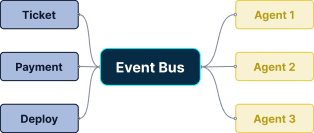
Event-Driven Architecture
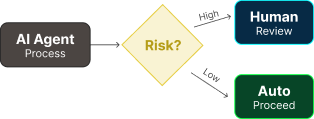
Human-in-the-Loop
Event-Driven Agent Architecture
In event-driven architectures, agents are triggered by real-time product events such as new support tickets, failed payments, code deployments, or churn signals. Asynchronous execution allows agents to operate in the background without blocking user interactions. Event buses such as Kafka or RabbitMQ route signals to the appropriate agent teams.
This pattern enables horizontal scalability. During peak traffic periods, such as Black Friday sales, thousands of order-processing agents can activate simultaneously without overwhelming core systems. Agents are instantiated only when needed, eliminating cold-start inefficiencies and improving overall system resilience.
Human-in-the-Loop Architecture
For high-risk or high-impact actions, human-in-the-loop mechanisms introduce intentional checkpoints. Transactions involving large financial values, production code deployments, or sensitive customer escalations are paused for human review and approval.
Advanced systems optimize this process by batching low-risk decisions for bulk approval, reducing cognitive load and context switching for human reviewers. Approval interfaces are designed for speed and clarity, often providing one-click approve or reject actions alongside concise agent reasoning. Risk scoring dynamically determines when escalation is required based on business impact and predefined thresholds.
Get in touch to discuss agentic AI development for SaaS, built for scale, security, and real-world workflows.
Explore More
How Product Managers Benefit From Well-Designed Agentic AI Architecture
Product Discovery & Insights Agents
Feedback synthesis pulls from Intercom, Zendesk, reviews, NPS across 50+ sources. Agents cluster pain points, quantify customer impact, surface rising signals before they become problems. Feature prioritization scores opportunities against revenue potential, engineering effort, strategic fit.
Roadmap & Release Automation
PRD drafting agents take stakeholder bullets and generate complete specs with success metrics, acceptance criteria, wireframes. Release notes compile changelogs, customer impact analysis, migration steps automatically. Sprint planning agents break epics optimally based on team velocity and dependencies.
Clean architecture means agents work across your exact tool stack, Jira, Confluence, Amplitude, Roadmunk, without custom glue code eating engineering time.
Enterprise-Grade Requirements for AI Agent Architecture
Production SaaS demands enterprise controls from day one. Role-based access controls mirror your current permissions, engineers see repos, support sees tickets, nobody touches production databases. SOC 2 readiness requires complete audit trails of every decision, data access, action taken.
Observability dashboards show real-time latency, accuracy, cost consumption across all agents. Cost controls cap token spend per workflow, route cheaper models for simple tasks, cache repeated queries. Drift detection alerts when agent behavior degrades from trained patterns.
Security architecture prevents common failures: input sanitization blocks prompt injection, rate limiting prevents abuse, encryption protects memory stores. Multi-tenant isolation ensures customer A never sees customer B data even on shared infrastructure.
Build vs Buy: Who Should Own This Architecture?
Off-the-shelf agents handle generic tasks, basic chat, and simple automation. They fail when workflows touch proprietary pricing logic, compliance rules, or multi-tool orchestration across 10+ SaaS systems.
Custom architecture becomes your competitive moat. Agents grounded in your specific usage data, pricing model, churn signals create defensible advantages. Internal teams lack AI architecture expertise, so most high-growth SaaS companies partner with specialists who understand both agent systems and SaaS scale.
The best approach combines platforms (reusable components) with customization (your secret sauce). Start with proven architecture patterns, specialize for competitive differentiation.
Conclusion
Agentic AI is quickly becoming a foundational part of modern SaaS architecture. Building systems that can reason, act, and scale reliably requires thoughtful design, strong governance, and a deep understanding of real-world SaaS workflows. When done right, agentic architectures enable teams to move faster while maintaining control, reliability, and trust.
As SaaS platforms evolve, the focus shifts from experimenting with agents to operationalizing them at scale. This requires architectures that are secure, compliant, and built to perform in production environments from day one.
Explore how high-performing agentic AI architectures can be designed for your SaaS platform.
Contact Us




Your email address will not be published. Required fields are marked *